Rachel Tucker is the Owner & Designer at Kimberfire - a brilliant way to buy diamond engagement rings, fine diamond jewellery, and loose diamonds in Toronto, ON and across Canada. She was born in Winnipeg and moved to Calgary in 1995 to pursue a degree in Fine Arts, majoring in Visual Communications and Illustration. Upon graduating, Rachel worked for several years in the fashion industry before becoming a fine jewellery designer in 2002. Creating everything from custom designed diamond engagement rings to belt buckles for the Calgary Stampede, Rachel honed her skills as a premier jewellery designer. She moved to Toronto in 2008 to work for and eventually become a partner at Platinum Unlimited where she became an award winning designer. She then started her own business, Rachel Tucker Studios in 2016, specializing in custom designed luxury pieces for exclusive jewellers across the country. In 2026, Rachel Tucker Studios acquired Kimberfire, Toronto's premier bridal jewellery concierge. Rachel now leads both companies as Owner & Designer, continuing to create outstanding, one-of-a-kind jewellery for clients throughout Canada.
Should You Sleep With Your Engagement Ring On?
Congratulations on your engagement! Once the ring is on your finger, a practical question follows fast: should you sleep with your engagement ring on?
The short answer: most jewellers recommend taking it off at night. Sleeping in your ring puts small, repeated stress on the prongs, lets it snag on bedding and hair, and traps moisture and grime under the stone. That said, plenty of people sleep in theirs for years without trouble. Here's how to weigh it for your ring and your habits.
Why take your engagement ring off at night
1. It protects the setting and the stone
Diamonds are the hardest natural material, so everyday scratches aren't the worry. But hard isn't the same as unbreakable: a sharp knock at the wrong angle can chip a diamond, especially at a thin edge or a point (think marquise, pear or princess cuts).
The bigger nighttime risk is the setting. Clenching your hands, sleeping with a hand under the pillow, or catching a prong on sheets or hair can slowly bend prongs and loosen the stone. You often won't notice until the stone is missing. High-set stones and pavé can also scratch skin, yours or your partner's. Softer gems such as emerald, opal, morganite and pearl are more vulnerable still.
2. Fingers swell overnight
Fluid shifts when you lie down, and heat, a salty dinner or a glass of wine add to it. A ring that fits perfectly at noon can feel tight at 3 a.m. and be hard to work over the knuckle in the morning. If your ring often feels snug at night, it may be worth having the sizing checked.
3. It's an easy moment to clean it
Lotion, soap, sunscreen and cooking oils build up behind the stone and dull its sparkle. Taking your ring off at night gives you a natural moment for a quick clean: warm water, a drop of mild dish soap and a soft toothbrush, then pat dry. (Do this over a bowl, not an open drain. For porous gems like opal, pearl or emerald, a damp cloth is gentler.) See our jewellery care guide for more.
4. Less trapped moisture
Hands can get warm and sweaty overnight. Moisture under a ring holds dirt against the stone and the skin, which can dull the ring and irritate your finger. A few ring-free hours each night helps with both.
5. Peace of mind
If you lie awake wondering whether you're damaging your ring, that's reason enough. Putting it somewhere safe lets you stop thinking about it and sleep.
Why some people keep it on
1. Sentimental value
For some, taking the ring off feels like setting aside what it stands for. They like having it on, always, as a quiet reminder of the commitment.
2. Less chance of misplacing it
Nightly removal carries its own risk. Rings left on the edge of a sink, buried in nightstand clutter or knocked into a laundry pile are a common way stones and rings go missing. If you're not confident you'll build a consistent habit, keeping it on may be the safer choice.
3. Travel
Hotel nightstands and bathroom counters are where rings get left behind. Some people keep their ring on while they're away for exactly that reason. If you'd rather take it off, bring a small ring case and keep it in the same zipped pocket every night.
4. A sturdy setting and a calm sleeper
Low-profile designs hold up well to daily wear. A bezel setting, which wraps metal around the stone's edge, protects it far better than tall claw prongs. If your setting is low and secure and you sleep lightly, the added risk is small. With a custom engagement ring, every one of these details, from setting height and prong style to the stone itself, can be designed around how the wearer lives.
How to decide
Take it off at night if any of these apply:
- Your setting is high or delicate: tall prongs, a halo, pavé or vintage filigree.
- Your stone is softer: emerald, opal, morganite or pearl.
- You're a restless sleeper: you toss, clench your hands or sleep with a hand under the pillow.
- Your ring feels tight at night: swelling and a snug fit make for a hard morning.
Keeping it on is more reasonable if your setting is low-profile (like a bezel), your stone is a diamond or sapphire, you sleep calmly, and you worry more about misplacing it than damaging it.
If you take it off: give it one home
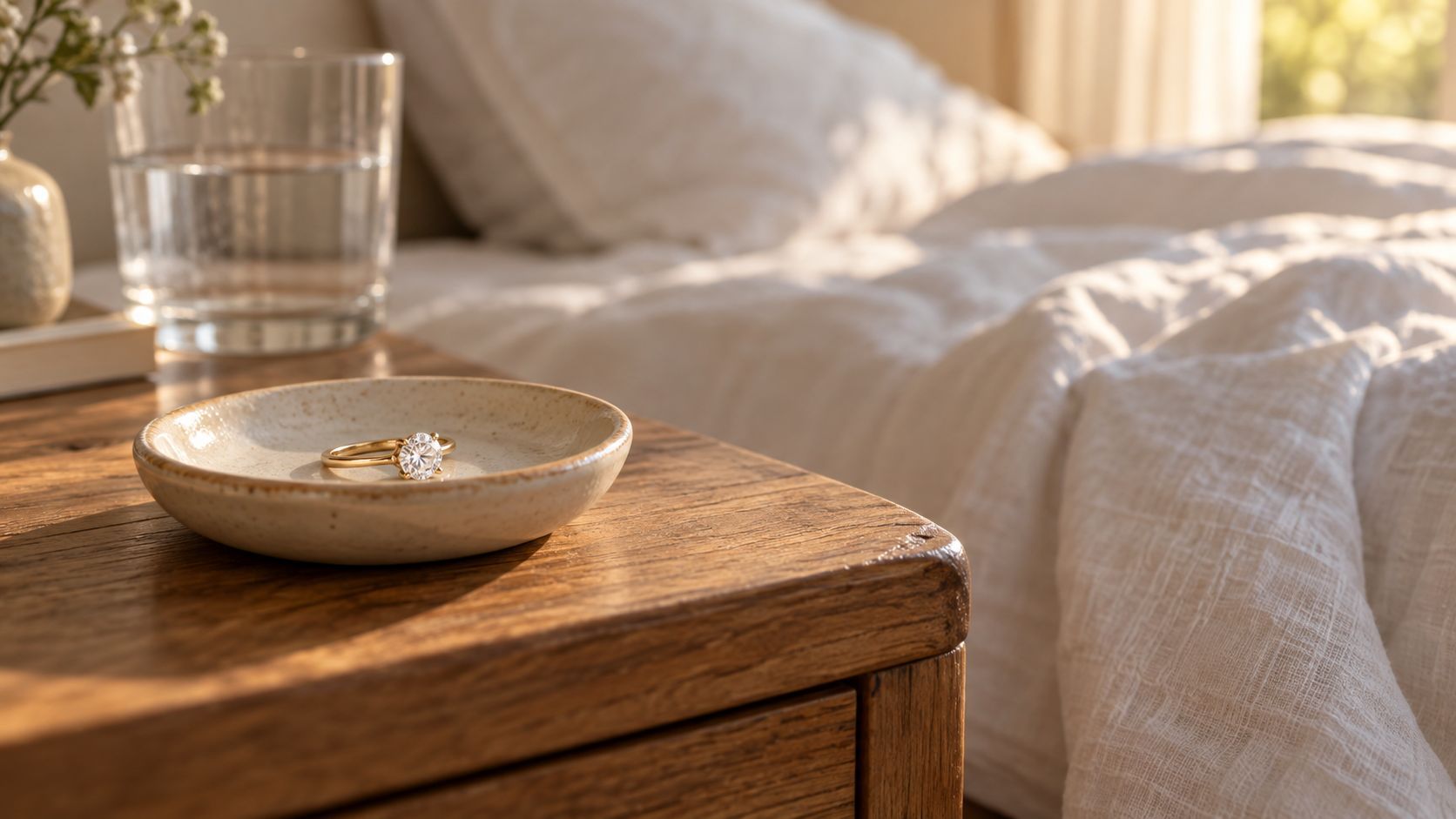
- Keep a ring dish or holder on your nightstand and use the same spot every night.
- Never set it on the edge of a sink or near a drain.
- When travelling, use a small lined ring case rather than a hotel nightstand.
If you keep it on: check it regularly
- Look at the prongs once a month. If one looks bent or catches on fabric, have it checked.
- Hold the ring near your ear and tap it gently. A clicking or rattling sound means the stone may be loose.
- Still take it off for the gym, heavy lifting, harsh cleaning products and pools.
Bonus tip from Kimberfire: get it inspected
Whatever you decide, have a jeweller clean and inspect your ring every 6 to 12 months. A quick prong check catches small problems before they turn into a lost stone, and keeps your engagement ring looking its best for years to come.
Frequently asked questions
Is it bad to sleep with your engagement ring on?
It isn't automatically harmful, but it adds wear. Over time, sleeping in a ring can bend prongs, loosen the stone and trap dirt. Most jewellers recommend taking it off, especially for high-set or delicate rings.
Can sleeping with a ring on damage it?
Yes. The most common damage is to the prongs, which bend gradually from snagging and pressure.
Diamonds rarely scratch, but they can chip from a sharp knock.
Should I take off my wedding band at night too?
A plain metal band has no prongs or stone to protect, so many people leave it on. Pavé or eternity bands deserve the same care as an engagement ring.
Why does my ring feel tighter at night or in the morning?
Fingers swell slightly when you lie down, especially after heat, salt, or alcohol. If your ring is regularly hard to remove in the morning, ask a jeweller about resizing.
How often should I clean my engagement ring?
A quick rinse at home once a week keeps it bright. Have a jeweller give it a professional clean and inspection every 6 to 12 months.
The bottom line
There's no wrong answer, only the one that fits your ring and your routine. If in doubt, take it off and give it a safe home on your nightstand. Either way, wear it with love and enjoy the road to your wedding day.

About Kimberfire
A brilliant way to buy high-quality custom engagement rings, diamonds, and jewellery. Discover expert guidance, complete transparency, and unmatched value in Toronto and across Canada.
Share this entry
Leave a Reply
Want to join the discussion?
Feel free to contribute!
You might also like